230W Electric Chainsaw Sharpener for Clean, Even Cuts
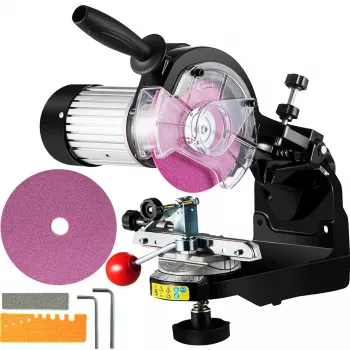
Electric Chainsaw Sharpener: 230W Chain Grinder with Adjustable Angles for Consistent, Clean Cuts
A sharp chain is the difference between a smooth day of cutting and a saw that fights every log. Our electric chainsaw sharpener uses a powered chain grinder with adjustable angles to help you bring each cutter back to a consistent shape, depth, and bite—without the guesswork that can creep in when you’re rushing a hand file.
What this sharpener is designed to solve
Chains don’t get dull all at once—they get gradually worse until cutting becomes slower, rougher, and harder on both you and the saw. A bench-style grinder is built to restore performance with repeatable geometry across the entire chain.
- Restores cutting performance when your chain starts throwing dust instead of chips, pulling to one side, or requiring extra pressure.
- Helps keep every cutter length consistent, which supports straighter cuts and reduces vibration.
- Speeds up sharpening compared with hand filing when you have multiple chains to maintain.
- Makes angle settings repeatable, reducing “close enough” sharpening that can shorten chain life over time.
Why adjustable angles matter on a chain grinder
Angle control is where an electric grinder earns its keep. When your top-plate angle and left/right cutters stay consistent, the saw can feed predictably instead of drifting, chattering, or making you compensate with extra pressure.
- Angle consistency: Matching the chain’s intended top-plate angle helps the saw cut efficiently without wandering.
- Left and right cutters: A stable setting makes it easier to sharpen both sides evenly, so the chain tracks straight.
- Material control: The right angle and light passes reduce overheating, which helps preserve cutter hardness.
- Repeat setup: Once you dial in angles for a chain, touch-ups later are faster and more uniform.
Practical angle checks before grinding
| Check | What to look for | Why it helps |
|---|---|---|
| Top-plate angle | Match the chain’s markings/manual spec | Keeps bite predictable and reduces side-pull |
| Cutter length | All teeth end up the same length | Supports straight cuts and smooth feed |
| Light passes | Multiple gentle grinds instead of one heavy cut | Limits heat and preserves edge durability |
| Both directions | Sharpen left cutters, then right cutters with the same setup discipline | Maintains balance across the chain |
What the 230W motor brings to the workbench
With a powered grinder, your goal isn’t to lean harder—it’s to let steady wheel speed do the work while you control contact time. A 230W motor is well-suited for routine chain maintenance where you want consistent results across tooth-to-tooth sharpening.
- Steady grinding power for routine maintenance without stalling under normal sharpening pressure.
- More control over the process: because material removal is efficient, it’s easier to use short, consistent touches instead of forcing a dull file.
- A strong fit for homeowners, wood cutters, and small shops that want repeatable results across multiple chains.
- Pairs well with a “set-and-repeat” workflow: set angles once, sharpen tooth-to-tooth, then swap chains and continue.
A simple sharpening routine that stays consistent
Consistency comes from a repeatable routine more than speed. Our team recommends building a habit that protects cutter hardness and keeps every tooth working as a matched set.
- Start clean: Brush off debris and wipe the chain so the wheel contacts metal, not grit.
- Inspect first: Replace damaged chains; sharpening can’t fix cracked cutters or unsafe components.
- Pick a reference tooth: Find the most damaged/shortest cutter and sharpen everything else to match its length for uniformity.
- Use light passes: Touch the wheel briefly, check progress, and repeat; avoid prolonged contact that can heat the cutter.
- Alternate sides methodically: Sharpen all cutters on one side, then reset for the opposite side so angles remain consistent.
Where this sharpener fits best
Safe setup and handling habits that protect chain and operator
A grinder is a power tool—secure setup and disciplined adjustments matter just as much as technique. For general chainsaw and chain-handling safety, we also recommend reviewing guidance from sources like OSHA, plus maintenance references from STIHL and Oregon.
Quick comparison: electric grinding vs. hand filing
Which approach matches the job?
| Job type | Hand filing | Electric chain grinder |
|---|---|---|
| Field touch-up during a cut | Best choice | Not practical away from the bench |
| Multiple chains in one session | Slower and technique-dependent | Fast and repeatable |
| Restoring a very dull chain | Possible but time-consuming | Efficient with controlled passes |
| Keeping cutter lengths uniform | Harder without jigs/guides | Easier to repeat tooth-to-tooth |
Product picks from our shop
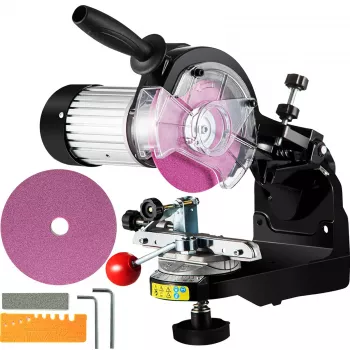
- Electric Chainsaw Sharpener – 230W Chain Grinder with Adjustable Angles — a bench-friendly option when you want consistent angles and repeatable sharpening sessions.
- LED Flashlight Smart Watch with Bluetooth Calling & 100+ Sports Modes — a handy add-on for the workbench or woodpile when you want quick light and easy call access while your hands are busy.
FAQ
How often should a chainsaw chain be sharpened?
Sharpen when the saw starts making dust instead of chips, needs extra pressure to feed, or begins cutting crooked. Light, frequent touch-ups are usually easier on the chain than waiting until it’s extremely dull—especially after you’ve hit dirt, sand, or a rock.
Will an electric chain grinder remove too much metal?
It can if you push hard or hold the wheel on the cutter too long, but you can control removal with light passes and consistent stops. Match every tooth to the shortest cutter and watch for overheating signs like discoloration, then back off pressure and contact time.
Do adjustable angles work for different chain types and sizes?
Adjustable angles are designed to help you match common chain sharpening specifications, but you should still follow your chain’s markings and the manufacturer’s manual. Once you dial in the correct angle for a specific chain, you can repeat that setup for faster re-sharpening later.















Leave a comment